Monday, March 23, 2015

Who is the church?


"The Church exists to connect people at the level of their hunger for a new world." 
-Rowan Williams


I had a dream last night. 

And I know that its not a good way to start out a blog about God or the church. The one's that usually start out with a dream become an ego trip wherein the only things that matter are one's interpretations of one's own subconscious experience. 

This might be one of those cases, you get to judge. 


So here's what happened:


"I am filing into a room. There are tons of people all around me also filing into a room. Its so crazy because there are tables where like twelve people are sitting and chairs for an audience. I know some people, but most are just people. Bodies in a room. We all sit down. And I make a joke or a dance or something (I can't remember). This was met with disapproval. After this I realized that the people at the table (again 12) were ushering people up one by one to share their story. I panicked because I realized they expected this of me."


Thought Break: This must be a point where I have to tell you a little about me. I don't have an interesting story. I grew up in a house where we didn't do very interesting things. I had to quit boy scouts because my parents wouldn't let me go camping. (my parents are awesome btw, don't confuse this with a statement to the contrary) In fact, the process of boy scouts is all about doing interesting things and getting badges. The only badge I ever got was the handshake badge. Swear to God. I went to a dry Christian campus. Never went to a party. In fact, the first time I was in the presence of alcohol I was 23. Not to say that drugs or alcohol are the definition of excitement but it just shows where I come from. I have never parasailed, or climbed a mountain, or driven a motorcycle, I could go on...for a while. 

Long story short, nothing of note. Played it safe. Nothing of interest. I went straight through school and am now waisting my life away doing a PhD in Christian Ethics and am spending the later part of my 20s nose deep in a book. No job probably on the horizon. People don't hire my degree (institution and area). Its not pessimistic, just honest. The most interesting things that have happened to me are my rockstar parents, my really interesting best friends (I have three: Patrick, Luke, and Jerry), and two amazing girls whom I fell deeply in love with and crashed and burned in a really non-fantastic way. Still recovering from those. Long story short two relationships that lasted combined probably less than a year, but loved them for what felt like a lifetime of energy. Enough of that sappy shit: So yea, nothing super bad, but nothing super amazing or adventurous. Case in point: I once made up a lie that I asked Taylor Swift out my freshman year of college to get people to like me and it has followed me like nothing else in my life. I am too afraid to start denying this LIE (not a yell, just to emphasize what it is and that I am kind of embarrassed) because it really is the most interesting about me. Again: the most interesting thing about me isn't even true...Back to the dream....


"So I panicked. And I left. Went to a Starbucks across the street. Yes thats right Starbucks is on every corner, including the fictional ones in my head. Saw someone I hadn't seen in years. Hugged her and told her I'd call. (it was a lie) Looked across the at the building these people were meeting at and for some strange reason went back over. Got in line and stood up in front of everyone. People were everywhere. Sitting in chairs, on tables, on the floor, you name it. They were all looking up at me waiting for me to speak. And so I told them about my boring life. I told them how I have always felt lonely and don't know why. Told them how scared I am that I made a mistake in wanting to become a theologian. Told them I get sad when I hear about weddings because I am selfish. I told them that I once got really excited because I was apart of a movie my friend was filming and I got to have a fake movie wife. I told them that even though I have more education than 98% of the world I feel like the dumbest person on this rock. I told them I felt like I am a burden to people and that I haven't really done anything of note. I told them that I think about how I wonder what it would be like to be someone else, and that sometimes I wish I was. I told them that I have only first world problems and feel guilty about being sad. I told them theology is so hard not because of content but because its an exercise in patience and prayer, and that I am not a patient person. I told them that I never asked Taylor Swift out, and am glad I didn't because I think she is lame.

...

"So then there was this warm silence. Like I could see everyone in the room at once and all of them were smiling at me. I felt like they cared. I felt heard, listened too, and, most importantly, understood. It wasn't a room of people who were worried about me or judgmental, but people that understood where my poultry pain was coming from and that it was real to me. It was amazing. I called them the church and then stepped down. No applause. No hugs. No comments. Just that warm silence. I could have sat in it forever. It was a beauty that I had not heard before and scare imagine I will again. But it was there for a moment. And for a moment it was the presence of Christ."


As a person trained to think theologically, I have thought many times about what it means to be the church. And I have had my idealistic moments. I believe the church is the place of sacramental theology where we become "like" the body and blood of Christ broken for the world. I believe the Church is the community of and for the poor, a community that risks everything for the least. I believe the church is the place of political revolution where the great become small and the small become great. I believe the church is the economy of the kingdom where value and worth are placed in a new light. I believe that the church is the place where we talk about old things like trinity, salvation, and sanctification. And these things matter. 

I believe all of that, but I think if I had to commit to one thing, the church is the place where people care about you. A place where people pray for you and who eat with you. They laugh with you in the joyful mundane things in your life and cry in the mundane things that hurt you. If Williams is right then my experience is a hungering for a new place that exists in multiple places, not just the not yet but the already. 

Please understand that I am not bitter that churches like this don't exist on every corner. I understand why they don't and don't blame anybody for that. I really don't. Jesus is talked about often and people pray for one another. It happens. I just pray for a place where even I can be this open. 

It is a radical idea a church that listens to one another in such a radical crazy way, and is semi-impossible to imagine. But maybe that's why a cloud of witnesses greeted me in my head at 9am this morning. 


Thursday, August 1, 2013

Imagining the Beautiful: It takes a community to be a pacifist...or at least it should.

"Blessed are the Peacemakers"-A Bumper Sticker...erg I mean Jesus.

"Nuke 'em till they glow"-A Bumper Sticker...definitely not Jesus. 

"God's own love for us is shown in his victorious deed of invasion in which he liberates us and calls into community." J. Louis Martyn 

So if you didn't know I am a pacifist. 

(Shocked?)

I also enjoy community and the church.

(WHAT ABOUT NOW?)

The problem is...I live in a part of the world where that is difficult. 

(Not just an American Problem, but it is an American Problem) 

However, I am beginning to see that those two combinations are in fact rare. For various reasons that I am about to name. 

1.) We would be insensitive to people who attend our church. 
  • The sheer size of our Armed Forces means that we will have someone in our community or someone related to or who is friends with a member of the Armed forces. They are in our Churches and we should not kick them out. (I do mean that) And that being the case saying things from the pulpit like "We think Killing People is Wrong" would be insensitive and push them away. 

2.) Too Radical and Not Pragmatic.
  • Christians are pro-people. A group of people who protects people, not bad right? I mean if you knew something about a group of people or person who was willing to kill millions and you stopped them would you? Wouldn't that be ok? 
  • Would you stop someone from assaulting a loved one? Would you think less of someone who sat by and watched? 


3.) *sung* LAST BUT NOT LEAST: Is the Bible really clear about non-violence? 
  • OT: Holy War, Genocide, (In fact the entire Deuternomistic History) David and Goliath, David in general, Israel in general, Psalm 137:9, etc.
  • NT: Jesus says buy swords, Jesus says the Kingdom of Heaven is for those who take it by force, Romans 13, Revelation 19, etc. 
  • BOOM!
Into this nexus we expect, somehow, our communities to be pacifist? 

NO THANK YOU SAYS I!

Oh Wait, never mind. I do. 

However,  Pacifists have functioned best as radical fringe people. People who were rolled over by the wheels of history, who allowed history to roll over them and somehow enacted the most change. Not all Pacifists, but a lot of them. 

Furthermore, communities can be a problem. We can think of the Household Codes in the NT from Paul. These are about communities. They subject people to the upward trajectory of their rule. For example, communities often oversimplify and poorly exegete texts like the Household Codes. But still, what about communities?

I want to tentatively go out on a limb and say that we still need to talk about communities, and that the abuse inflicted by communities does not prevent what Paul and Jesus liked and wanted. And since communities called Churches find themselves dealing with the Bible, lets talk about the Bible.

Here's two quotes to consider:

Dietrich Bonhoeffer,
"The Christian cannot simply take for granted the privilege of living among other Christians." (This in addition to everything else he says in chapter 1 of Life Together...or just read all of it) 

Richard Hays (Talking about Paul),
"The constant factor is that he (Paul) imagines God's eschatological salvation in corporate terms: God transforms and saves a people, not atomized individuals. Consequently, the faithful find their identity and vocation in the world as the body of Christ."

I choose these quotes because they help us put in perspective the Biblical passages that we so often misquote, misunderstand, and just plain miss. And these quotes help locate this often quoted and rarely understood passage in its proper perspective.

For just as the body is one and has many members, and all the members of the body, though many, are one body, so it is with Christ. For in the one Spirit we were all baptized into one body—Jews or Greeks, slaves or free—and we were all made to drink of one Spirit. (1 Cor 12:12-13) 

Its hard to grasp the gravity of this passage without acknowledging the world shattering statement that it is making. I cannot go into the complexities, but it is worth saying that the the relationship between Jews/Gentiles and Slaves/Free (though it would have been better if he said Masters, but hey) was tumultuous. The community created by Jesus (or should I say made possible by Jesus) is counter cultural and counter intuitive from the culture it finds itself in. (Read Bonhoeffer's Discipleship and Life Together for a complete picture on this) This is obvious of the Biblical world and no reason to thinks it changed. But why do we still struggle with that. It is clear that we trapped in habits and practices of sin that influence our readings of the Bible. (This is Hauerwas speaking)

Furthermore, the Bible has lost its counter-cultural message because we have ceased to read it that way. And Rather use it as a weapon to affirm our own subjectivities. As Stanley "the manly" Hauerwas says,

"[Some] read the Bible not as Christians, not as people set apart, but as democratic citizens who think their 'common sense' is sufficient for 'understanding' Scripture."

So maybe its not an issue of right principles or pragmatics, but of imagination. Anytime the Bible or the Church locates itself along side systems of violence (i.e. slavery, Jew/Gentile violence, etc) then we are not reading the Bible with enough imagination or in the way it was intended. The Community that Jesus opens up, and to which the NT witnesses to, is a community opened up in light of systems of violence. It's not easy and as Bonhoeffer said should not be taken for granted, but it is a reality made possible by Christ.

So whats the deal? How does all this fit together?

Here's the summary to this point:

1. I am a pacifist and believer in Christian community.

2. There are several roadblocks in the contemporary Church that prevent people from holding these positions practically and exegetically.

3. Maybe there is some ambiguity with these texts and the ambiguity arises from our cultural position?

So what do I think is at stake?

Listen to this sermon.   

Saying Stop

These are individuals, but there is a sense that whole communities need to be in the practice of saying stop. Somehow in the logics of what we understand as peace needs to be played out. The logics of what Jesus does in saying stop.

SIDE BAR

***Now there is a very specific crucial point I want to clarify. There is a sense in which this equation of saying stop can be reversed on its head. The sense in which, arrogantly, the Church sees its daily life as peaceful and read that back on Christ. Now it may look similar and that might sound right, but that is a very dangerous step. One can make a lot of assumptions.

Its the wrong direction. It allows for the coercive interpretation of community that can justify anything in its communal life as a reflection of the life of God. This is especially troubling when we observe Church history and times when the Church has made assumptions about itself (culturally or otherwise) and linked it closely with salvation. (i.e. Crusades, colonialism, and aspects of WWI&II) You can see how these cultural epochs take the person and body of Jesus and transmute it to make claims about the world that carry the weight of salvation. In short, we must be clear: community does not produce character. Jesus produces character and therefore also community.

Rather, the direction is opposite. Jesus radically interrupts our reality. (see quote above from Martyn) As Bonhoeffer is famous for, the gospel is a gospel of costly grace. It is a call to come and die.

***Side note: the call to come and die is usually coded under some American masculine sense of being eager and willing to die. Its less in the sense of discipleship and used to justify things like war. (AGAIN IMAGINATION)***

Thus the call to discipleship is difficult, its not comfortable.***

SIDE BAR OVER

When the community commits to "saying stop" it will look surprising.

Consider This===>Amish Grace
(WARNING: This video is a bit cheesy)

Consider this story again as narrated by David Steinmetz.
October 13, 2006
DURHAM--I thought I had lost the capacity to be shocked. After all, the slaughter of the innocents is nothing new. My wife and I have a dark memento of gratuitous cruelty to children, a poster from the Holocaust Museum that shows a group of Jewish children, already separated from their parents and waiting quietly for the freight trains that will take them to Auschwitz or Buchenwald, where -- if they are lucky -- they will suffer a swift death.
But the recent murder of young Amish girls in a one-room schoolhouse in Nickel Mines, Pa., slipped past the defenses I thought I had safely in place. The act seemed so unexpected, so random, so senselessly cruel, so out of place with the tranquil setting of the school or the peaceful ideals of the Amish themselves, that it was difficult to take in, much less to understand.
The shooter, Charles Carl Roberts, knew the Amish girls would not resist, though he brought restraints with him, just to be safe, especially since (as it appears) he intended to abuse them sexually before he murdered them. But the Amish school teacher, alarmed by his behavior, slipped out the back door, ran to a neighbor's house and did what must have seemed to Roberts the un-Amish act of calling the police. Their unanticipated arrival upset his timetableand saved the girls from rape, if not from his angry gunfire.
Nonviolence is a way of life among he Amish, who, like the Mennonites, are descendants of a 16th century radical Christian group called Anabaptists. Anabaptists were particularly impressed by the teaching of Jesus on the subject of nonviolence. They read the commandments of Jesus to turn the other cheek, to renounce the sword, to return good for evil and to forgive one's enemies, as rules binding on all Christians and not just on some subgroup of the especially pious.
In their view Christians could not be soldiers, because soldiers are required to take human life in time of war, or magistrates, because magistrates are duty bound to order violence done in the name of justice. The command to use no violence against another human being and to forgive unjust wrongs was absolute and admitted of no exceptions. As the Lord's Prayer made perfectly clear to the Anabaptists (and to their Amish descendants), forgiveness is not extended to the unforgiving. Forgive us as we forgive is the intractable rule.
And so the Amish forgave Roberts for imprisoning their children, for maiming and murdering them, and even for intending to molest them while they were helplessly in his power. They forgave him, not because he had been driven by private demons or because his act was anything but heinous. They forgave him because they thought Jesus had told them to and they were not clever enough to think he didn't mean it.
Forgiveness is tough work, and forgiving the unforgivable unimaginably hard. Most of us, whatever our faith commitments or lack of them, would have to whisper a prayer -- at least to "the close and holy darkness" for the grace of a bad memory, before struggling to forgive much smaller wrongs.
After a while, news of fresh acts of violence against children loses its power to shock, even when it still dismays.
But the Amish matched their words with deeds. They invited Roberts' widow to the funerals of their children, insisted that some of the money raised to help them be used to help her, andeven attended the graveside service of the man who had so cruelly wrested their children from them.
By doing so, the unworldly but morally substantial Amish gave their worldly but morally less substantial fellow citizens a brief glimpse of a peaceable kingdom, where the lion lies down with the lamb, where swords will be beaten into plowshares, where violence ceases and a gentle magnanimity reigns.
You can't say it is impossible or hopelessly utopian, because you have just seen it done. 
(David C. Steinmetz is the Amos Ragan Kearns professor of the History of Christianity at the Divinity School of Duke University. He is a former resident of Lancaster County, Pa.) 

Steinmetz draws the reader into a world to set the seemingly abnormal (forgiveness and peace) against the backdrop of our notions of normal (revenge and hate) to show the modern Christians the world they should inhabit, not the one they in fact do.

This is why I think communities and pacifism go together. When a community can band together and perform this type of non-violent response it creates a space where this type of living can be seen not as idealist jargon, but as a living practice of faith.

If this story, or these words shock, then part of it is the theological imagination we are preaching.

***I guess it is important to note that it did happen, and it was surprising to us all. It should. Actions like this help interrupt and should be encouraged. Its not that we try and normalize surprising action, but that we don't forget where the horizon actually leads.***

I think of the book Gilead and the John Ames', main character, grandfather who was a country preacher during the time leading up to the Civil War. The grandfather confessed experiencing the revelation of God that the war was of God. But in the end, the confidence of this old country preacher was gone. John Ames reflects,

"...he preached his people into that war..."

As Ames goes one he mentions that his grandfather felt a great deal of grief. He must have. Looking out and seeing all the widows, orphans, and loved ones of the men he had sent to their deaths.

Ames reflects,

"I suspect he knew he couldn't preach life back into a church that had lost so much as his had."

He would hire himself out as a worker to his congregation, to the point of almost abandoning his own family. This was his penance. The guilt was palpable. Its never simple to preach it and we shouldn't say that it is.

***So what's all this mean? Stop Quoting Stuff and Get To the Point!***

Simply put...maybe we are preaching the wrong imagination. Maybe the reason we find it so hard to imagine a world without violence is because we refuse to see, preach, and practice such a world that Christ calls into being and hands to us.

So, boldly and humbly, the problem of soldiers in our midst is that sometimes we preach them into it, or maybe not.

I am open to conversation, not yelling.

Either way, we need to seriously evaluate our Christian imagination and ask weather it resembles a re-fried patriotism. Civil Religion is not the same as the practice of following Jesus. Simply put: To make disciples of all nations is incompatible war.

The fact that so many emotions surround this issue and we cannot have a civil conversation in the Church shows us something too. This is a lot, so here are some key points I want to be clear about. (I also hope this answers our three roadblocks above)

  • I believe community should be something struggled for and not something coercive.
  • Furthermore, communities should be examined in how they treat the marginal. 
  • Communities can be places of extreme affirmation in the Christian journey and places that encourage neighbor love, charity, and hope. FURTHERMORE, if communities can embody the principles of non-violence, like the Amish in Nickel Mines, they can be creative, nurturing spaces for those who want to embody those principles and thus represent the logic of new creation. 
  • I think pacifism is unpopular because we don't preach and practice it. (Be it that we think its unpopular or not.) 
  • We avoid difficult conversations about pacifism because we know the emotions it brings up. 
  • Judgment falls on us all, so there is no need to easily pass it out. 
  • I am not sure what I would do in a situation where innocent people, loved ones, or even myself were in life threatening danger. I don't. However, I do know assenting to violence before hand leads to death almost certainly. Pacifism may fail to protect innocence but war and violence fails as well and more often than not leads to more unnecessary death. That type of assent to future violence is a bad Christian imagination. We must remember, we are not the future...Jesus is the future. 
  • This doesn't mean I want to celebrate the death of soldiers, or that it should mean that soldiers should be kicked out of the Church. (I don't think we should do that with anyone to be honest) 
  • But it doesn't mean that we should equate war with Christian missions, that American Freedom is equal with God's, and that we should celebrate the death of any casualty of war. 
  • The very fact that in our wars Christians kill other Christians in the name of country should tell us something. 
  • The Bible as a whole needs to be read, re-read, and read again in conference with other people and the guidance of the Church, tradition, theology, and other cultures in order to begin to get at answers to these types of questions of community and war. We cannot simply throw some Bible verses at it and make it go away. Life isn't that simple and neither should war...or community. 
  • It also means that we should reconsider the word 'enemy' in light of the great commission. 
  • It also means that forgiveness should be given a fair hearing as a way of practicing Christianity.
  • At the very least we need to question the way that the war on terror is happening, especially the rise of drone killings. 

There are a lot of things to consider, but certainly we have to consider these things. It might be radical but through out history Christianity always has been. We might ask ourselves why the present age is different. And why we so violently defend it...


Monday, July 1, 2013

Children, Mr. Rogers, and the Christian Moral Imagination.

I have always heard that Moral Theology and Christian Ethics lies not so much in knowing the right information, but in knowing the right questions to ask. If this is so, then I contend that Mr. Rogers is one of the greatest examples of Christian Moral Theology.

If you, by a terrible twist of fate, do not know who Mr. Rogers is or are just unfamiliar with him, read this article and WATCH ALL THE VIDEOS EMBEDDED!!!!!!!! But seriously you will not regret it.

Take a moment just click on this link =>Mr. Rogers as Moral Agent. 

Now I trust that you watched and read everything.

Anyway, if the moral life is about knowing the right questions to ask, then to be moral includes being intimately involved in the situations within which moral action is being called for.

***Now it seems appropriate to acknowledge that Christianity and the Moral are not good partners. I am unsure how to negotiate the relationship between the two since Ethics and Morality arise directly from the Fall. However, one cannot fail to acknowledge that Christian lives possess ethical implications. And so for that reason I use the word Moral, though it be imperfect.***

Back to Mr. Rogers.

According to Rowan Williams, correct rearing of our children has become a great moral challenge.

He writes of what has become a misunderstanding of childhood,

"Childhood, after all, is a period we've come to think of as 'latency', the time before certain determinations and decisions have to be made." (Williams, 11) 

This latency is seen as something that is to be born, a kind of waiting period or ritual before the child has become a mature moral agent.

In this modern conception, childhood is understood very impatiently.

This view of childhood, of latency, makes the child, in their own way, a subject of economic and moral pressure. Acted on, and expected to mature past childhood in order to become an active participant capitalistic economy of value. Pushed to mature. Everything prior to that maturation, tossed aside as irrelevant. Games to fill time before real meaning can be assigned. Meaning that in some cases the child's play is allowed, but never taken seriously. What is serious is the 'real' world that the parents already live into and the child awaits.

Play is illogical. Adulthood is logical. The real world has no need of it.

Returning to Williams, and one of my favorite quotes, about Alan Garner's book, The Moon of Gomrath. Williams writes, (its long sorry)

"Throughout the book, we're made aware of a tantalizing oddity, a sort of detachment and chill, in the behavior of the 'light-elves'; and, fairly well on in the narrative, an explanation is offered by another of the 'fairy' species. The elves fight with bows and arrows, not hand-to-hand, with swords: they kill at a distance, without seeing the eyes of their victims. 'You will find in the bows of the lios-altar much to explain their nature, which was not always as now.' But human beings use bow and arrows, don't they? And guns? So the child reader might ask. Well indeed: now look at human beings again, a bit more carefully. What might the difference be between knowing you're killing a specific person and indiscriminate slaughter? And does the latter make you another kind of person? We we not always as now?" (19)    

Ironic. We as Moral Theologians, Christian ethicists labor for the right questions, yet here in the child's imagination in play here they are.

Williams continues,

"This kind of moral exploration, by way of the play between the familiar and the often outrageously strange, is properly a function of all imaginative writing; and the fictional space as an opportunity for testing styles and identities - even at the level of the suburban soap - goes on being important for anyone trying actively to relate to the world." (19) 

The abandoning of this type of play and the solidifying of 'real world' moralities keeps the consistent questioning, or rather right questioning, that the Christian life requires aloft.

HOWEVER, it is important to know that not all play is equal. What I mean is that some play is relatively, or explicitly violent.

Hey, I grew up on the Power Rangers. So I am guilty. To this day I am still captivated by it. The intro tells you enough.


So what kinds of play? Enter, Fred Rogers.

It was not enough for Mr. Rogers to tell kids what to do, but created an entire world, or neighborhood in which the kids could enter. This was the "Neighborhood of Make Believe."

It was a magical place, oft quirky and cheesy according to today's standards, but it was a place of safety that kids could go. It was a place where dramas were played out in front of their eyes between characters like Tuesday and Friday (to orient them to the mundane). These dramas were dramas that looked fantastic but were familiar to the kids who watched them. As Rowan Williams said above, it allows them to test identities. If you wonder if he was able to know the things that ailed kids, just think about the fact that he wrote a whole song about not getting sucked down the drain.


But still, this fantasy world was a safe place where one could see 'friends' go through the daily struggles kids had to go through. What's the importance you ask? To ask the right questions, and to have the confidence that a friend cared, who understood. And ultimately the words spoken to the child was, "You are special and valuable." Sometimes the moral life arises out of the confidence that we are loved and understood. This also gives us the space to play, and be allowed to test the waters of identity with the patience of friend.

Furthermore, Sometimes the moral life requires the possibility of seeing a world where the right choice is normative. The Neighborhood of Make Believe was such a place. The fantasy world helps the child ask the right questions, test identities, and see the possibility of right living through the questions. Its hard to watch Mr. Rogers and his neighborhood and see that choices of violence, persecution, and anger are possible courses of action. Rather, it forms the child, the human, to be a creature that recognizes that valuableness and sacredness of the other. Namely, to see them as friends in the neighborhood. This new fantasy world assists in the establishing of a new imagination. Don't believe me? Watch this episode.

Be Yourself

Now, Christ is never mentioned by Mr. Rogers. I get that. But, Fred Rogers was an ordained minister. He did his education while filming the show and chose to give his life to the formation of the Child's imagination. You think he would be theological intentionally.

But then I contemplate the person and work of Christ.

You cannot deny the Christ-o-logic of this method. Because isn't it the mission of Christ to give a new imagination to humanity caught in cycles of violence? Does he not give us the imagination, the vision to see to a new world beyond our own? And furthermore, does he not give us the confidence that we are loved? Even unto the end of the age?

Don't think it was intentional? Listen to his speech at his induction into the TV Hall of Fame.

Hall of Fame Speech.

Or re-watch this speech.

Life Time Achievement Speech.

So maybe it wasn't Sunday School exactly, but it provides the imagination to see a magical world where lives can be formed in Christian love. Its the kind of therapeutic Christian imagination that we would need to cure our own violence and possibly the violence of the whole world.

And so I close with this story:

Fred Rogers once received a letter from a young boy who suffered from some type of developmental disorder that would send him into fits of rage. He was an avid watcher of Mr. Roger's neighborhood. He asked Mr. Rogers that if he was ever in his neighborhood, if he would come by. So, Mr. Rogers one day finding himself near this boy and with a few hours to spare rented a car and sought out this boy along with his handler.

(Note: Mr. Rogers had a handler not because he was vain or felt he was in danger, but because he was so present with whoever he was with he would have never gotten anywhere with out them.)

When they got their the boy was in such a state of excitement, but quickly it turned to rage as he was unable to calm himself and act the way he wanted in front of his TV friend. Into this situation, Mr. Rogers now sitting in the living room with this boy said, "Will you pray for me?" For some reason, this calmed the boy. They prayed. Fred Rogers visited a little bit longer and bid the family farewell. As he and his handler got back in the car she asked him, "That was quite a psychological trick, giving him volition in a situation where he had no control in order to calm down." Fred Rogers looked puzzled and then chuckled and said in a tone only he could muster. "Oh heavens no. I figured if a boy of his age could survive such things, he would be the one I would want to pray for me."

Knowing the right question to ask. Would you pray for me? It seems to simple to be true, but for Fred Rogers it was a part of a nexus of imagination that made such responses possible.

Maybe when we are confused about what to do in the violence in our world. What action to take, we might imagine returning to that neighborhood of make believe. To remember a man who spent his life helping kids find the right questions and the confidence that they were special and loved.

And I think its worth closing with a song he wrote, Goodnight God.          


Saturday, December 15, 2012

The Fulfillment of Life: Newtown and The Tree of Life


"They will beat their swords into plowshares, and their spears into pruning hooks." Isaiah 2:4


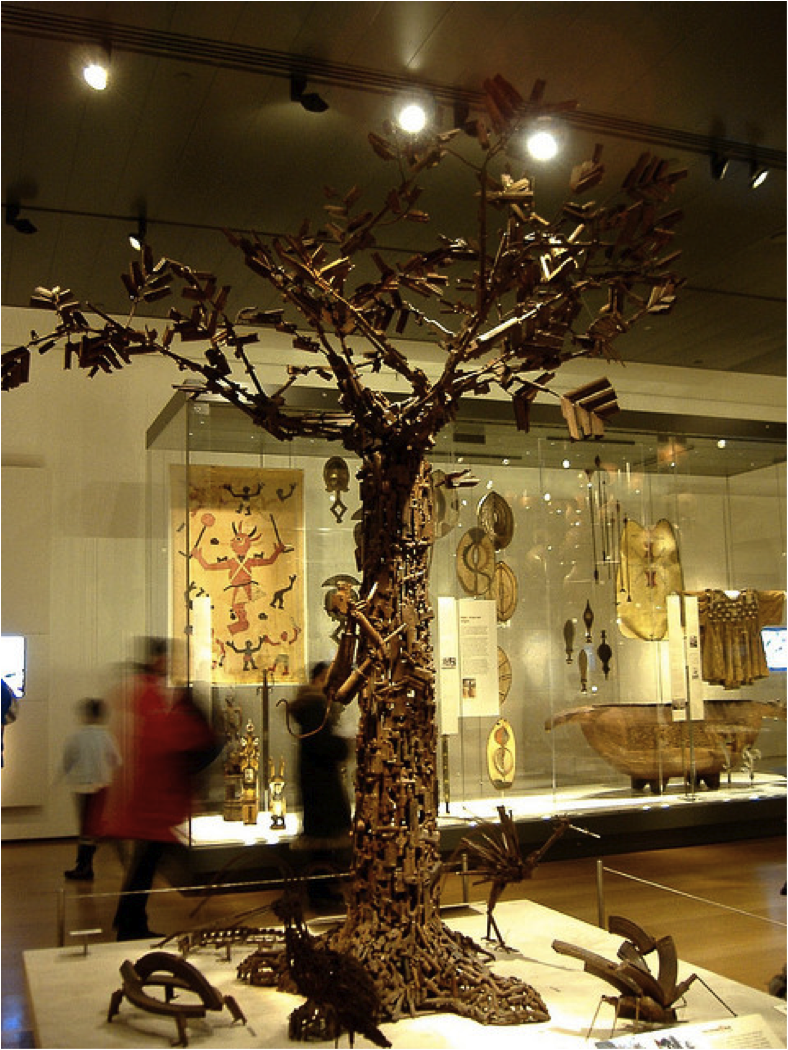
This is a beautiful, beautiful piece of art. I aways, always tear up when I look at it.   

The phrase, "I had thought I had lost my ability to be surprised" I borrow from David Steinmetz professor of Church History at Duke Divinity School on the heels of the Nickel Mines, PA Amish school shooting. I have not talked to him about what happened at CT but I am sure he would agree this is just as surprising if not more so. Twenty Seven Dead, 20 of them just babies. Babies with their whole life in front of them. My heart aches and hurts when I think about it. It makes me sick. 

For some reason this sculpture is all I can think about...

The Tree of Life sculpture displayedrecently in the British Museum of Art in February 2005, was made as a part of the Transforming Arms into Tools initiative in the post-Civil War country of Mozambique.  It represents an imaginative vision ofthe passage in Isaiah 2:4 where it is written “They will beat their swords into plowshares, and their spears into pruning hooks.” It is a quite literaldepiction of this biblical prophecy due to the materials used in the sculpture, namely decommission weapons.  The passage and the sculpture relate to each other in a very intimate way.  I think the Tree of Life gives imagination to the Isaiah prophesy and in turn the Isaiah prophecy makes sense of the sheer oddity of the formation of the sculpture itself. 
                Isaiah’s prophecy functions historically in a time where a vision of a new reality is needed.  With Isaiah’s prophecy signals a shift in prophetic speech from merely informing present events but also future ones as well.  This particular passage,2:4, in its entirety reads, “He shall judge between the nations, and shall arbitrate for many peoples; theyshall beat their swords into ploughshares, and their spears into pruning-hooks; nation shall not lift up sword against nation, neither shall they learn war any more.” During this periodthere was a large amount of political strife in the kingdom of Israel andJudah.  This was a period (namely the 8th Century) when Judah was influential enough to be a force in world events.  This was long before the Babylonian Exile and contemporary with the fall of the Northern Kingdom.  What was needed from the Lord was a vision of a future whose situation was peaceful.  This was a message of hope for thepeople, that after exile came restoration and the end of war between nations.  Isaiah 2:4 is situated as a part of a larger universal prophecy (chapters 2-4) meant to offer salvation to all.  In this hopeful future, weapons of war (swords and spears) shall be beaten into tools of peaceful existence (plowshares and pruning hooks). 
            Likewise, the Tree of Life sculpture is made to commemorate a contemporary example of this hope, the later twentieth centurycivil wars in Mozambique.  Between the years 1976-1992 the country was plunged into civil war amid competingpowers in the nation.  In addition,world powers with interest in the area poured approximately seven million weapons into the country to continue and enforce the war.  After the Civil wars had ceased local Bishops and Christian artists sought to create communal images that the nation could hold to begin the process of reconciliation and more importantly conceptually envision a non-violent existence.  This started the Transforming Arms into Tools initiative where citizens would exchange their weapons forvaluable tools such as sowing machines and plows.  The Tree of Life (above) is a sculpture made out of those weapons collected and decommissioned by the Mozambique civil government. AK-47s, handguns, and ammunition clips make up the structure of the sculptureas they have been cannibalized to fit the form of a tree, which is meant todraw to mind the tree of life depicted in Revelation 22.  It is a beautiful structure, where the trunk is made of the remains of tools of death and the leaves are hollow magazine clips.  This transformation is the healing and transforming of a bloody past.  Here citizens of once warring people give up their weapons for the tools of peace while transforming weapons intopeaceful beauty.
            These two works are meant to make sense of one another.  On the one hand Isaiah’s vision is grounded in the speculative, leaving the reader and hearer to wonder what that might look in aconcrete situation.  On the other,what does one gain from turning guns into a tree? 
            The future hope of deliverance from strife that Isaiah wishes to point to is meantto signify harmony unseen to his contemporaries and still to modernreaders.  In the sculpture, the weapons signify a peaceful end and a new image for the things Mozambique citizens used to commit murder against one another.  After a twenty-year period of civil war it takes creativity to transform the social imagination of violence to peace, and the artistsbehind the sculptor give voice to a liberation from violence by literally beating swords/guns into a tree of life while handing out plowshares.  These two works, Isaiah and Tree of Life, make sense of one another because The Tree of Life gives us the tangible form of what Isaiah meant by the hope for transformation of weapons into objects of peace.  Isaiah, also, gives us the cipher on which to interpret the Tree of Life as a work of art.  For if we did not have the vision of a time when swords would be beaten into plowshares then the making of a tree out of automaticweapons would be a meaningless gesture. These two works give us a hope of a time when “nation will not lift upsword against nation and peace reigns.”

 The observer of the Tree ofLife should be perplexed yet moved. Perplexed at the leaves meant to signify new life thatare made from magazine cartridges.  In Revelation 22 it is written, 
Then the angel showed me the river of the water of life, bright as crystal, flowing from the throne of God and of the Lamb through the middle of the street of the city. On either side of the river is the tree of life with its twelve kinds of fruit, producing its fruit each month; and the leaves of the tree are for the healing of the nations. Nothing accursed will be found there any more. But the throne of God and of the Lamb will be in it, and his servants will worship him; they will see his face, and his name will be on their foreheads. And there will be no more night; they need no light of lamp or sun, for the Lord God will be their light, and they will reign forever and ever. Rev. 22: 1-5
We become moved because of the hope in a time when the weapons of warwill have no use but to be made into trees and works of beauty.  This tree in particular shows a world struggling against war a peaceable kingdom where swords will be beaten intoplowshares and spears into pruning hooks. This tree witnesses to reality as it should be.  We cannot call this work of art hopelessly utopian because it is rooted in the struggles of Mozambique and the transformations Isaiah prophesies.  

So, why a tree? Why art? Why now? In times like these do we not have better things to do? It is true, we owe it to the victims to be in solidarity with them. I think thats what Jesus would do. 

Our problem is to learn how to mourn. Mourning and lament in the wake of tragedy rather than screams of gun control or gun ownership expansion deal with pain in a realistic and redemptive. The fact that we think that more violence, more guns would beget peace is outrageous. That somehow more guns near children solve the issue, I am not convinced. 

For example, two days before this tragedy in Newtown a man shot his son after trying to sell his handgun in Penn. (http://www.theblaze.com/stories/tragedy-as-father-accidentally-shoots-7-year-old-son-outside-penn-gun-shop/) 

It did not make national news. But this should cause us pause about the ways we deal with tragedy, death, and violence. 

This tree represents God's way of dealing with violence. 

But I am convinced that death is not the final say. As Nicolas Wolterstorff, writes on the loss of his son
To believe in Christ's rising from the grave is to accept it as a sign of our own rising from our graves. If for each of us it was our destiny to be obliterated, and for all of us together it was our destiny to fade away without a trace, then not Christ's rising but my dear son's early dying would be the logo of our fate. (Lament For a Son, pg. 92)

Furthermore, images such as the Tree of life symbolize our fate. The fate of the world at the hands of a God who does not abandon creation to its own violence.

We think whoever has the most bullets lowers crime and ends war, but the only time war ceases and violence stops is when those things are beaten into plowshares and pruning hooks.

Its reality transformed and assigns the only amount of worth to our weapons amount to, torn apart to make a divine statement that death shall not have the final say.

That guns and weapons ultimately serve as the paint on the eschatological work of art.

The reason I think on this work of art, is that it is a window. A window to the future that is breaking in on us. It is a reminder that the reality where children's bodies aren't subjected to unspeakable horrors. Rather, it is a reality where
rather than showing us how the tears of a small girl suffering in the dark were necessary for the building of the Kingdom, he will instead raise her up and wipe away all the tears from her eyes - and there shall be no more death, nor sorrow, nor crying, nor any more pain, for the former things will have passed away, and he that sits upon the throne will say, 'Behold, I make all things new.' (DBH, Doors of the Sea, 104) 
The children's fate lies with this reality. This should not cause us to abandon grief and lament or give cheap answers to bewildered parents. Rather, it provides the overarching context for discussions once the time for talk has begun.

I think of this painting because if a window to that eschatological place needed to be seen it is time like these. Because it reminds us that it is not idealistic hope to yearn for this, but is a reality which comes to us in a tree.

Maybe even a tree such as this...


Saturday, July 21, 2012

We Interrupt This Program: Ramblings on a Misunderstood Verse

"Greater love hath no man than this, that a man lay down his life for his friends."
John 15:13 (KJV)

"Nonresistance is right, in the deepest sense...because it anticipates the triumph of the Lamb that was slain."
John Howard Yoder


****Sorry this is like my 8th blog on non-violence, more on Cinema and Creed to come****

Sooooooooo, I was in Target the other day where all great theology flows. I was waiting for a prescription to be filled when a lady struck up a conversation. She asked where I was from, what I was doing in Durham, etc. Finally it came up I was in Seminary. She got excited and so did I. So we talked Church talk and some other things before she asked the question, "I think its great we live in America, A Christian nation where we are free to worship don't you?" 

Usually I just cheekly nod and let it pass, but stupidly I didn't this time. I said, "Well this place is home and I like home, but I don't think Christians owe the nation anything for any privilege to worship God or not. I just think that's a bad way to look at it."

She was not expecting this response.

She fired back this: "Well what about all the wars that we have fought to preserve freedom of worship."

I, calmly, said, "Well I am a pacifist. I don't like war. I think war is awful. And besides we have not fought a war like that in a long long time."

She then cocked her hip and placed her hand on it. She then lifted her head slightly and said, "Well, There is no greater love than this, that a man would lay down his life for his friend." 

She obviously thought this one liner would end the conversation.

We Christians have a terrible way of throwing out a single line of Scripture thinking that it ends conversations like these with no further explaination. However, this is like throwing a tarp over a junk heap and expecting people not to notice the smell.

Anyway, we talked for a few more minutes politely and she smiled and left once her prescription was filled.  I on the way home came to one conclusion:

We believe in war.

In fact, War points to the fundamental beliefs of society. (Democracy,  Liberty, Freedom, Capitalism, etc.) Both inside and outside the Church, we argue tooth and nail for it, because we fundamentally believe that it will bring about a better world rather than merely a more violent one. So, we scoff passionately at the idea of non-violence. It seems logically impossible in our society to even have a perspective of global relations where war isn't the major influential force that gives meaning. The old adage "If you want peace, prepare for war" is a logical impossibility.

Furthermore, the more disturbing notion is the lack of credibility non-violence has among Christians.

If we look longer at the text, and read it in its entirety we might note that Jesus is talking about himself who lays down his life for his friends (the world). We should read this text as saying Jesus lays his life down for those in his closest circle, but rather Christ dies for all. This is so basic to Christian teaching its almost not worth saying. So when Christ says love has no greater meaning than to lay down life for a friend, he talks about his love for those in whom he lays down his life for (those who are about to crucify him) without resisting. Christ communicates God's love by laying down his own life for those friends who would murder him.    

It's ironic this passage is being used to communicate the killing of enemies for the sake of a few and the holiness of war rather than its original intention of the peaceful loving of all, despite the consequences.  And it is even more ironic that in the Church, war is more rational than pacifism.

The love of war runs deeper than than Christian convictions. And so we believe in war, but we only kind of believe in Christ.

I think its because killing takes but a moment, and forgiveness takes a life time...

 So I have come to this conclusion. We must say that either Christ does not conquer the world through peace, or we must admit that Christ lays down his life for the world in order to save it making it impossible for us to save the world by killing. And then also admit that we much rather prefer killing people.

This conversation is more important than ever in light of another shooting. Most argue that the right to carry would have saved these people. However, so could a Church who loves the shooter first (before such things happen) thus making such an incident impossible. 


Wednesday, July 11, 2012

Creed and Media 1: The Father Almighty and Tron Legacy

I believe in one God the Father Almighty, maker of heaven and earth, and of all things visible and invisible...


Rowan Williams writes in Tokens of Trust (TT), "God is to be trusted as we would trust a loving parent, whose commitment to is is inexhaustible, whose purposes for us are unfailingly generous." (pg 19) 

The hardest thing to get in the life of faith is that God cares. I do not know why that is the case. For whatever reason whenever the worst happens, God cares. It would be easier to believe that God did not care so that we could discard God once and for all. However, this is not the case. Somehow we have to reckon the awfulness of life and a loving God trying to find a way to reconcile the two. We have to trust that God is continuously acting towards us in a generous way, or acting toward us in a way which redeems the awfulness. This is not to say that God causes the awful things in our lives to bring the best out for us. Rather, God only acts toward us in an extremely generous way and only good. 

I believe this is what is meant by God being the "Father Almighty, maker of heaven and earth, and of all things visible and invisible." The things that we need, the things that bring us wholeness are basic to the ways God has created to us. God created us to be happy (beatitude). However, to know what completes us/makes us happy involves the deep knowledge of the one who makes us and who is almighty, capable of making us happy.

Tron Legacy is a movie about just this. The sequel to the Disney classic reboots the micro world envisioned by its creator Flynn. However, Flynn lives two lives. One in the real world and one in the cyber world. In order to maintain order in both worlds (the cyber and the real one) Flynn creates in his own image "Clue" to maintain the cyber world. Eventually, Clue rebels against his creator and tries to create for himself the "perfect system". Clue murders and destroys many programs (cybernetic equivalent of people) in order to fill that emptiness meant for his relationship with Flynn. Ultimately Flynn, out of love for Clue, his son, and the system reunites Clue with his own being destroying himself in order to bring balance. It is Flynn and Flynn alone who can set everything right. 

Granted, this movie lacks certain aspects of the Creedal confession of God the Father. God cannot die in the absolute since as Flynn does. However, the God of the Creed is the Father Almighty who brings about the greatest things for it. It is not necessarily that Flynn destroys Clue (and himself) but that God possesses the power to bring completeness to the system THAT GOD MADE. 

The only one who knows how to complete is the one who made it in the first place. 

I am drawn to this because often times texts don't come. They just don't. Loneliness happens, it does. That incompleteness can only be fixed through a one who acts generous toward me. This acting is miraculous. Because a miracle is none other than an incomplete creation's incomprehensible emptiness being filled. Can't explain it. Just sometimes the creation opens up to its creator and is brought to its completion. This rehearses the ultimate completion that comes to all in the eschaton. 

Thus, why am I drawn to this display of faith? I have no idea, just every now and then I am drawn to the holy in ways that I do not expect, but nevertheless was what I need. Can't manufacture it, just longingly trust the one who acts generously, the Almighty maker of heaven and earth. 

Saturday, June 23, 2012

Trust, The Nicene Creed, and Media

We live in a media charged culture.

I don't lament this fact. Mostly because the movies, TV, music, even news relies on concepts that only make sense within the Christian Narrative. And thus the pain caused by the perversion of these concepts only are converted, saved, and redeemed by the same Christian Narrative.

The fact that both Christians and non-Christians might believe culture can be conceived without the person of Christ is staggering. Furthermore, If it were possible, with some sort of super-magnet, to pull up out of that history every scrap of metal bearing at least a trace of His name, how much would be left? (Pelikan)

Thus, this blog will be an introduction to a series of blogs I hope to do on explaining the Nicene Creed through popular media. This is in order not to say that we need media to understand the Creed, but that the media needs the faith in order to explain its own display of these concepts.

I believe this is important because when we don't receive that text we have been waiting what feels like a life time for, when you lose that job that is the only thing you know how to do, and when that person dies that you loved with all your heart...when that happens that broken heart, thirst for justice, etc it is the lamentation of the fullness of Christian theological understandings. Culture tries to save itself by recycling these symbols and concepts but it never fully saves itself only prolongs the inevitable.

Then the task of this new blog set then will show how we have trusted the wrong things in light of trying to achieve happiness (beatitude). We have trusted, for example, love for love's sake, peace for peace's sake, justice for justice's sake, etc rather than the peace, love, justice that exists as a gift of God alone and within God alone. These concepts are largely unachievable without the Triune God especially in today's contemporary world.

Not saying that those non-Christians cannot love someone, but that there exists a fullness in the Triune God which simultaneously is its source and fullness.

So what will follow, hopefully, is an engagement with pop-culture in the theological framework of the Creed. And, I hope to show where trust belongs.